Final Fantasy II
Square's 1988 role-playing game for the Famicom, the second in the series.
Final Fantasy II is a role-playing game by Square, released for the Famicom in Japan on 17 December 19881, the second game of the Final Fantasy series2. Four warriors set out to save a world that the Emperor of Palamecia is bringing under his rule3. The game has no character classes, experience points, or levels. Characters grow in whatever they do: a weapon or spell gets stronger the more it is used4, and a character’s stats follow how they fight5. Important words heard in conversation can be memorized and asked about later6. Square’s advertisements sold the game on its growth system and its word-memory conversations, and one ad called the growth system a landmark for the Famicom RPG7.
Hironobu Sakaguchi directed the game8. Famitsu credits its game design to Akitoshi Kawazu9, who shares that credit with Hiromichi Tanaka and Kouichi Ishii8 and has called Final Fantasy II “basically my system”10. Kenji Terada wrote the scenario, Yoshitaka Amano designed the characters, and Nobuo Uematsu composed the music; the credits list Nasir Gebelli first among the programmers8.
As transcribed by fans, Famicom Tsushin’s four reviewers scored it 9, 9, 9, and 8 out of 1011. One praised a story that went narrow and deep where Dragon Quest’s world was broad and shallow, but found the battles sluggish. Another said the skill levels made for long grinding, more than made up for by a superb scenario12. In 1994 Square’s publicity manager, Yusuke Hirata, put its sales at about 800,00013,13. With its re-releases, Square Enix counted 1.28 million14 copies shipped by March 200314. Famitsu’s report of a 2015 talk by Sakaguchi says the game wasn’t released overseas, and that the game sold in North America as Final Fantasy II was Final Fantasy IV15. Kawazu carried its growth by use into his next game, SaGa16.
#How it plays
Characters never level up. Each weapon type and each spell has its own skill level, which rises with use and makes it stronger4. Stats move with what a character does in battle, not with the number of battles fought. Fighting with a weapon raises Strength, and casting spells raises Intelligence or Spirit5. Famitsu’s 2023 retrospective adds that taking damage raised maximum HP, and that the abilities pull against each other: a rise in Strength could lower Intelligence17. A character who casts a lot becomes a mage, Kawazu said, without the player choosing it at the start18.
Asked about players attacking their own party to make it stronger, Kawazu said he hadn’t foreseen it. He had let a character hit a sleeping ally to wake it faster, and never expected it to become a way to raise hit points19.
Outside battle, a chime marks an important word in conversation, shown in brackets. The player can memorize it, then ask other characters about any word they have memorized6. The first word learned is the rebels’ password, “wild rose”20. Ships and an airship carry the party across the world21.
The story opens with the party beaten and wiped out at once. Firion, who lost his home to the Palamecian Empire’s invasion, joins the rebels against the Emperor, and companions die one after another as it goes on22.
#Attacks
A trained fighter swings several times in one attack, and the target tries to dodge several times; every successful dodge cancels a hit23. Each hit that gets through rolls its own damage, from the attack to twice the attack, less the target’s defense. About one hit in twenty is a critical that adds the attack again24. A weapon matched to the target’s weakness hits as if it were 20 points stronger25. Running works on the runner’s own chance to dodge, so an evasive character gets away more often26.
#Development
Kawazu said the classes went for two reasons. The team wanted a more story-driven game, which needed specific characters in set roles, and growth was to come from nurture rather than nature18. The end credits list Masafumi Miyamoto as producer8.
#Across the series
Final Fantasy gives each swing one roll against a hit chance that already has the defender’s evade taken off. Final Fantasy II splits that in two: the attacker’s hit rolls against the defender’s evade rolls27.
Kawazu said he took the lessons of Final Fantasy II into SaGa, keeping its growth by use but adding races so the characters wouldn’t all end up alike16.
Square Electronic Arts set Final Fantasy Origins, PlayStation remakes of the first two games, for North America on 8 April 200328. Retronauts calls the Japan-only WonderSwan Color remake the basis of the later Game Boy Advance and PSP versions29. Nintendo of America released the Game Boy Advance collection Final Fantasy I & II: Dawn of Souls on 29 November 2004. Its Final Fantasy II adds a story that follows four characters who die in the main game into the afterlife30. Square Enix’s Japanese site dates the Pixel Remaster’s release on Steam and smartphones to 29 July 2021, with those of the first and third games31.
Mechanics
| Mechanic | Kind | How |
|---|---|---|
| Hit chance | Hit rolls less evade rolls | every dodge the target makes cancels one of the attacker's hits, so an evasive enemy blunts a flurry |
| Multi-hit attack | Hits less evades | a trained fighter swings several times in one attack, and each swing that gets past the target's dodges deals its own damage |
| Damage formula | Attack minus defense | each hit deals between the attack and twice it, less the target's defense |
| Critical hit | Fixed | about one hit in twenty is critical, whatever the weapon, and adds the attack again |
| Elemental weakness | Flat bonus | a weapon the target is weak to hits as if it were 20 points stronger |
| Fleeing | Own evade | the better a character dodges, the likelier they are to get away |
Every claim about this game, by concept (30)
References
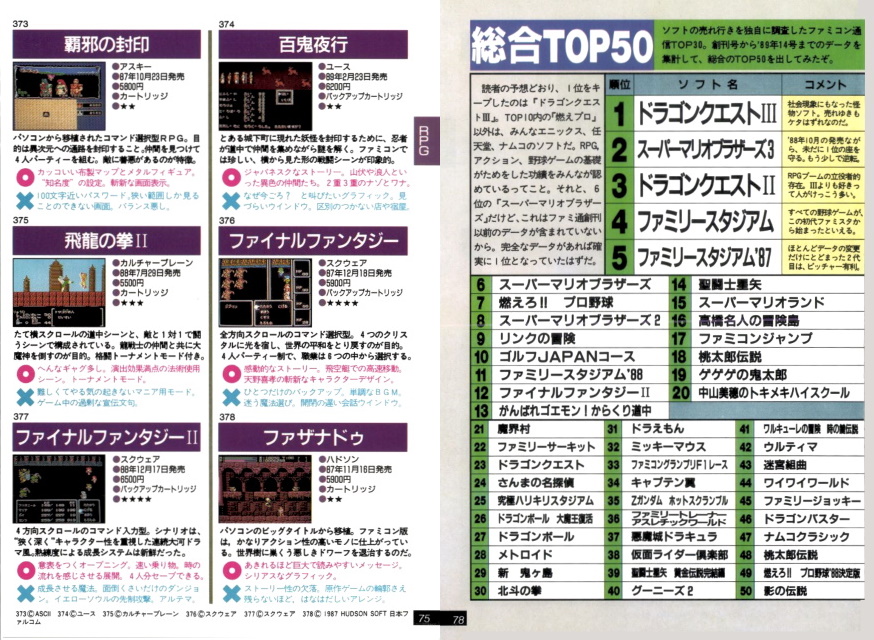
- ^Final Fantasy II came out for the Famicom in Japan on 17 December 1988.PublisherNintendo, VC Final Fantasy II · Famitsu '89 All Software Catalog p.78 · Electronic Gaming Monthly 63
How we know
このゲームは1988年12月17日にファミリーコンピュータで発売された
first paragraph · archived copy ↗ 88年12月17日発売
p. 75, entry 377 · archived copy ↗ The Famicom FF2 and FF3 were respectively launched in December 1988 and April 1990.
p. 172, interview with Yusuke Hirata · archived copy ↗ The quote matches our archived copy.
Checked by a second AI model, 2026-10-23.
- ^Nintendo calls Final Fantasy II the second game of the Final Fantasy series.PublisherNintendo, VC Final Fantasy II
How we know
『ファイナルファンタジー』シリーズの第2弾です
first paragraph · archived copy ↗ The quote matches our archived copy.
Checked by a second AI model, 2026-10-23.
- ^Four warriors set out to save a world that the Emperor of Palamecia is bringing under his rule; Nintendo of America's press release calls them a band of orphans who lead a resistance against an evil empire.PublisherNintendo, VC Final Fantasy II · Nintendo, Dawn of Souls press release
How we know
パラメキア皇帝によって支配されつつある世界を救うべく、主人公である4人の戦士が冒険へと旅立ちます。
first paragraph · archived copy ↗ In "FINAL FANTASY II," a band of orphans leads a resistance force to free the world from the clutches of an evil empire.
press release, on Final Fantasy II · archived copy ↗ The quote matches our archived copy.
Checked by a second AI model, 2026-10-23.
- ^ abFinal Fantasy II has no character classes, experience points, or levels. The abilities a character uses are the ones that grow: each weapon type and spell has its own skill level, which rises the more it is used, and its power with it.ManualFinal Fantasy II Famicom manual · Nintendo, VC Final Fantasy II
How we know
職業や経験値といった考え方はありません
p. 38, 成長, first paragraph · archived copy ↗ 基本的には、使った能力が成長するという考え方で、それぞれの成長のシステムが作られています。 … 武器や魔法を使えば使うほどそれぞれの熟練度が上がり、それに従い絶大な威力を発揮する様になっています
p. 38, 成長, second paragraph · archived copy ↗ このゲームには経験値やレベルといった考えかたはありません。
growth section · archived copy ↗ The quote matches our archived copy.
Checked by a second AI model, 2026-10-23.
- ^ abA character's stats change with what they do in battle, not with the number of battles: fighting with a weapon raises Strength, and casting spells raises Intelligence or Spirit.ManualFinal Fantasy II Famicom manual · Nintendo, VC Final Fantasy II
How we know
戦い方や1つ1つの戦闘の内容によって、それぞれの数値が変化していく様になっています
p. 38, 成長, third paragraph · archived copy ↗ 武器で攻撃する「たたかう」という行動では、「ちから」というパラメータが上がり、魔法で攻撃する「まほう」では、「ちせい」や「せいしん」が上がる
growth section · archived copy ↗ The quote matches our archived copy.
Checked by a second AI model, 2026-10-23.
- ^ abWhen a conversation turns up an important word, a chime sounds and the word is bracketed; the player can memorize it, and later ask other characters about any memorized word.ManualFinal Fantasy II Famicom manual
How we know
会話の中に重要な単語があるとチャイムが鳴り、単語は【 】でくくって表示されます。
p. 8, 情報収集, ★おぼえる · archived copy ↗ コマンドウインドで“たずねる”コマンドを選ぶと、ワードウインドが開き
p. 9, 情報収集, ★たずねる · archived copy ↗ The quote matches our archived copy.
Checked by a second AI model, 2026-10-23.
- ^Square's Famicom Tsushin advertisements, one before release and one after, sold the game on a growth system without experience points, in which weapons and spells grow stronger with use, and on WMS, a new conversation system built on memorized words. The pre-release one called the growth system a landmark that would transform the Famicom RPG.MagazineFamitsu 61, FFII preview ad · Famitsu 65-66revised
How we know
武器、魔法に成長要素を持たせ、使い込むほどその威力が増してゆくというもの … ただ強い武器を持てばよかった従来のファミコンR・P・Gを革新する画期的なシステムといえるだろう
advertisement, scan leaf n100 · archived copy ↗ 経験値のない成長システム … 覚えた単語の情報収集ができる新・会話システム
p. 53, Square advertisement · archived copy ↗ 情報収集を変えた新・対話システム“WMS”
advertisement, scan leaf n100 · archived copy ↗ The quote matches our archived copy.
Revised after a check by a second AI model, 2026-10-23.
- ^ abcdThe end credits name Hironobu Sakaguchi as director and Masafumi Miyamoto as producer; Hiromichi Tanaka, Akitoshi Kawazu, and Kouichi Ishii for game design; Kenji Terada for the scenario; Yoshitaka Amano for character design; Nasir Gebelli first among the programmers; and Nobuo Uematsu for music.Codeeverything8215, FF2 disassembly · Final Fantasy II Famicom manual · Famitsu 65-66, FFII ad
How we know
25565; "PROGRAM\n NASIR GEBELLI"
255660E/BE24: 10 12 0F 07 12 01 0D FF 18 0E 01 13 09 12 18 07
255670E/BE34: 05 02 05 0C 0C 09 00
⋮
255700E/BE3B: 13 03 05 0E 01 12 09 0F FF 18 0B 05 0E 0A 09 18
255710E/BE4B: 14 05 12 01 04 01 00
⋮
255740E/BE52: 03 08 01 12 01 03 14 05 12 18 04 05 13 09 07 0E
255750E/BE62: FF 18 19 0F 13 08 09 14 01 0B 01 18 01 0D 01 0E
255760E/BE72: 0F 00
⋮
255790E/BE74: 07 01 0D 05 18 04 05 13 09 07 0E FF 18 08 09 12
255800E/BE84: 0F 0D 09 03 08 09 18 14 01 0E 01 0B 01 00
⋮
255830E/BE92: 07 01 0D 05 18 04 05 13 09 07 0E FF 18 01 0B 09
255840E/BEA2: 14 0F 13 08 09 18 0B 01 17 01 1A 15 00
⋮
ff2j.asm lines 25565–25633 at 8d26190 · upstream ↗ CHARACTER DESIGN : YOSHITAKA AMANO
p. 48, Project Staff · archived copy ↗ MUSIC: NOBUO UEMATSU
advertisement p. 53, staff line · archived copy ↗ Checked against the evidence by its author, an AI model, 2026-10-25.
Checked by a second AI model, 2026-10-23.
Checked by a second AI model, 2026-10-25.
- ^Famitsu's 2023 retrospective credits the game design to Akitoshi Kawazu, later producer of the SaGa series.WebFamitsu, FFII 35th anniversaryrevised
How we know
本作のゲームデザイン部分は、のちに『サガ』シリーズのプロデューサーとなる河津秋敏氏が手掛けています。
paragraph beginning 本作のゲームデザイン部分は · archived copy ↗ The quote matches our archived copy.
Revised after a check by a second AI model, 2026-10-23.
- ^Kawazu has called Final Fantasy II "basically my system".InterviewRetronauts, Kawazu interview 2017revised
How we know
Final Fantasy II was basically my system
answer on Final Fantasy III's class system · archived copy ↗ The quote matches our archived copy.
Revised after a check by a second AI model, 2026-10-23.
- ^Fan transcriptions of Famicom Tsushin's cross review give Final Fantasy II scores of 9, 9, 9, and 8 out of 10 from its four reviewers, a total of 35 out of 40.WikidataGEIMIN, Famitsu cross-review list · Legendius, FFII cross reviewrevised
How we know
35 ( 9/ 9/ 9/ 8)
row 234, FC ファイナルファンタジーII · archived copy ↗ TACO.X 8点
the four review boxes · archived copy ↗ The quote matches our archived copy.
Revised after a check by a second AI model, 2026-10-23.
- ^In Famicom Tsushin's cross review, as transcribed on a fan page, Tōfuya Famibō (9) praised a scenario the player could get involved in, narrow and deep where Dragon Quest was broad and shallow, but found the battles sluggish and the second half's story slack. TACO.X (8) said the strain of swapping experience for skill levels showed in long grinding, more than made up for by a superb scenario.WebLegendius, FFII cross reviewrevised
How we know
とにかくシナリオがいい。感情移入できるのだ。『ドラクエ』が広く浅くの世界を設置していたのに対し、逆に狭く深くの展開。 … ただし、戦闘はたるい。後半ストーリーがだれるのものナニ。
東府屋ファミ坊, 9点 · archived copy ↗ 経験値をなくして熟練度を採用した新システムのしわよせが、ゲームのなかにちょこちょこ顔を出している。レベル上げの時間が長いんだよね。 … 終盤のつらさとこの欠点を補ってあまりあるのが、絶妙なシナリオ
TACO.X, 8点 · archived copy ↗ The quote matches our archived copy.
Revised after a check by a second AI model, 2026-10-23.
- ^ abSquare's publicity manager Yusuke Hirata told Electronic Gaming Monthly in 1994 that the Famicom Final Fantasy II sold about 800,000 copies.MagazineElectronic Gaming Monthly 63
How we know
Their sales were approximately 800,000 and 1.4 million units respectively.
p. 172, interview with Yusuke Hirata · archived copy ↗ The quote matches our archived copy.
Checked by a second AI model, 2026-10-23.
- ^ abSquare Enix counted 1.28 million copies of Final Fantasy II shipped by 31 March 2003 across its NES, PlayStation, and other versions, 1.08 million of them in Japan and 0.2 million abroad.PublisherSquare Enix IR shipments table 2004
How we know
NES/PS/Other 1,080 200 1,280
p. 27, table of titles shipping over 1 million · archived copy ↗ The quote matches our archived copy.
Checked by a second AI model, 2026-10-23.
- ^Famitsu's report of Sakaguchi's 2015 talk says Final Fantasy II and III were released in Japan but not overseas, and that the game sold in North America as Final Fantasy II was Final Fantasy IV; in 1994 Square's Hirata said the Famicom FF2 and FF3 were never translated.WebFamitsu, Sakaguchi talk 2015 · Electronic Gaming Monthly 63
How we know
海外ではこの2作は発売されなかった … 北米で『Final Fantasy II』として発売されたのは、スーパーファミコン(北米ではSuper Nintendo Entertainment System)で登場した『ファイナルファンタジーIV』だ。
section 海外での展開は手さぐりが続く · archived copy ↗ These were never translated.
p. 172, interview with Yusuke Hirata · archived copy ↗ The quote matches our archived copy.
Checked by a second AI model, 2026-10-23.
- ^ abKawazu said that he took the lessons of Final Fantasy II into his next game, SaGa (Final Fantasy Legend), keeping its nurture system but adding races so that the characters wouldn't all end up as clones of each other.InterviewRetronauts, Kawazu interview 2017
How we know
I did learn a lot from Final Fantasy II, and I incorporated those lessons into SaGa.
answer on SaGa as a successor · archived copy ↗ So for SaGa, I wanted to incorporate that kind of nurture system, but I needed to differentiate the characters so that they wouldn't all be clones of each other at the end. That's where the races came in.
answer on SaGa's races · archived copy ↗ AK: SaGa [Final Fantasy Legend].
answer naming his next project · archived copy ↗ The quote matches our archived copy.
Checked by a second AI model, 2026-10-23.
- ^Famitsu's 2023 retrospective says that physical attacks raised Strength and taking damage raised maximum HP, and that opposed abilities couldn't both be built, since a rise in Strength could lower Intelligence.WebFamitsu, FFII 35th anniversary
How we know
物理攻撃をすれば力が上がり、ダメージを受ければ最大HPが上がるというように、戦闘の行動によって直接ステータスが上昇するものでした … 力が上がると知性が下がるなど、相反する能力は両立できないので、よく考える必要がありました
paragraph beginning 『II』に関しては · archived copy ↗ The quote matches our archived copy.
Checked by a second AI model, 2026-10-23.
- ^ abKawazu said classes were dropped for two reasons: the team wanted a more story-driven game, which needed specific characters in set roles, and growth was to be nurture rather than nature, so a character who used a lot of magic would become a mage over the whole game.InterviewRetronauts, Kawazu interview 2017
How we know
we wanted a more story-driven game for the second Final Fantasy. Obviously, we needed specific characters to fulfill certain roles within the story … The argument was that the system is more about nurture than nature now. … If one character uses a lot of magic, then they'll naturally become a mage.
answer on Final Fantasy II's skill system · archived copy ↗ The quote matches our archived copy.
Checked by a second AI model, 2026-10-23.
- ^Asked whether he had foreseen players attacking their own party members to get stronger, Kawazu said he had no idea people would use it to grind; he had let characters hit a sleeping ally to wake it faster, and never realized it would become a way to raise hit points.InterviewRetronauts, Kawazu interview 2017
How we know
I had no idea people would use it to essentially grind levels. … I thought that if characters were put to sleep, well, it makes sense to wake them up faster by hitting them. … I never realized it would become a way to increase your hit points or whatever.
answer on attacking party members · archived copy ↗ The quote matches our archived copy.
Checked by a second AI model, 2026-10-23.
- ^Famitsu's 2023 retrospective says the story advances by memorizing and using keywords, and that the first word learned is the rebels' password, "wild rose" (のばら).WebFamitsu, FFII 35th anniversary
How we know
特定のキーワードを記憶・使用することで物語を進行させるワードメモリーシステムも採用されました … 最初に覚えるのが反乱軍の合言葉である“のばら”なので
paragraph beginning また、バトル以外だと · archived copy ↗ The quote matches our archived copy.
Checked by a second AI model, 2026-10-23.
- ^The party travels the world by vehicles such as ships and an airship.PublisherNintendo, VC Final Fantasy II
How we know
このゲームでは、船や飛空船といった乗り物を使って世界中を冒険します。
second section · archived copy ↗ The quote matches our archived copy.
Checked by a second AI model, 2026-10-23.
- ^Famitsu's 2023 retrospective sums up the story as Firion, who lost his home to the Palamecian Empire's invasion, joining the rebel army to challenge the Emperor. It calls the opening, in which the party is wiped out by enemies at once, novel, and recalls the companions lost one after another as the story goes on.WebFamitsu, FFII 35th anniversary
How we know
パラメキア帝国の侵略で故郷を失ったフリオニールが反乱軍に参加し、皇帝に戦いを挑むというもの … 冒頭でいきなり敵にやられて全滅するという演出が斬新でしたし … つぎつぎと犠牲になる仲間たちにも心を痛めました
paragraph beginning ストーリーは · archived copy ↗ The quote matches our archived copy.
Checked by a second AI model, 2026-10-23.
- ^A Fight action rolls 0–100 once per point of the attacker's hit multiplier (adjusted by haste or slow, at least 1) and counts the rolls under its hit %, then rolls once per point of the target's evade multiplier and counts the rolls under its evade %. The evaded rolls are subtracted from the hits, at least 0, and the rest are the hits that deal damage. Blind halves the attacker's hit % and the target's evade %. The check returns no successes when the attacker is a toad or mini, and the disassembly marks as a bug that the evade check reads the attacker's status too.Codeeverything8215, FF2 disassembly
How we know
16227; [ do fight effect ]
⋮
162300C/AFBF: B1 9F     LDA ($9F),Y        ; main hand hit multiplier
⋮
162330C/AFC4: 71 9F     ADC ($9F),Y        ; add haste/slow modifier
⋮
162400C/AFD1: E9 14     SBC #$14           ; subtract 20
⋮
162460C/AFDD: A2 01     LDX #$01           ; min 1
⋮
162510C/AFE6: B1 9F     LDA ($9F),Y        ; main hand hit %
⋮
162570C/AFF3: F0 04     BEQ $AFF9          ; branch if not blind
⋮
162600C/AFF9: 20 2C BC  JSR $BC2C          ; check for hit
⋮
162620C/AFFE: 85 52     STA $52            ; +$52: number of successful hits
⋮
162660C/B006: B1 A1     LDA ($A1),Y        ; target's evade multiplier
⋮
162690C/B00B: B1 A1     LDA ($A1),Y        ; target's evade %
⋮
162790C/B020: 20 2C BC  JSR $BC2C          ; check for hit
⋮
ff2j.asm lines 16227–16290 at 8d26190 · upstream ↗ 17943; [ check for hit ] ⋮ 17945; $44: hit % 17946; $46: number of hit attempts 17947; $48: number of successful hits (out) ⋮ 17949; *** bug *** should use target status for evade checks ⋮ 179510C/BC2C: A9 00 LDA #$00 ; start with 0 hits ⋮ 179610C/BC40: A4 46 LDY $46 179620C/BC42: A2 00 LDX #$00 179630C/BC44: A9 64 LDA #$64 179640C/BC46: 20 11 FD JSR $FD11 ; random (X..A) 179650C/BC49: 38 SEC 179660C/BC4A: E5 44 SBC $44 ⋮
ff2j.asm lines 17943–17971 at 8d26190 · upstream ↗ Checked against the evidence by its author, an AI model, 2026-10-21.
Checked by a second AI model, 2026-10-21.
- ^Each hit that gets through deals attack plus a random 0 to attack, less the target's defense (at least 0), and the hits add up. Each hit also rolls 0–100, and a roll under 5 makes it critical, adding the attack again.Codeeverything8215, FF2 disassembly
How we know
18008; [ calculate damage ]
⋮
18010;  $44: attack
18011;  $46: defense
18012;  $48: number of hits
18013; +$4A: damage
⋮
18030; start of hit loop
180310C/BCA7: A2 00     LDX #$00
180320C/BCA9: A5 44     LDA $44
180330C/BCAB: 20 11 FD  JSR $FD11          ; random (X..A)
180340C/BCAE: 18        CLC
180350C/BCAF: 65 44     ADC $44            ; attack * (0..1)
⋮
180410C/BCBA: A5 4C     LDA $4C            ; subtract defense
⋮
ff2j.asm lines 18008–18074 at 8d26190 · upstream ↗ Checked against the evidence by its author, an AI model, 2026-10-21.
Checked by a second AI model, 2026-10-21.
- ^When the weapon's type bonus matches the target's type, or the weapon's element matches one of the target's weak elements, the attack power gains 20 before the damage is rolled.Codeeverything8215, FF2 disassembly
How we know
163320C/B086: B1 9F     LDA ($9F),Y        ; main hand attack power
⋮
163370C/B090: B1 9F     LDA ($9F),Y        ; main hand type bonus
163380C/B092: A0 15     LDY #$15
163390C/B094: 31 A1     AND ($A1),Y        ; target type
163400C/B096: D0 0A     BNE $B0A2
163410C/B098: A0 1B     LDY #$1B
163420C/B09A: B1 9F     LDA ($9F),Y        ; main hand element
163430C/B09C: A0 16     LDY #$16
163440C/B09E: 31 A1     AND ($A1),Y        ; target weak elements
163450C/B0A0: F0 0D     BEQ $B0AF
163460C/B0A2: 18        CLC
163470C/B0A3: A5 44     LDA $44
⋮
ff2j.asm lines 16331–16360 at 8d26190 · upstream ↗ Checked against the evidence by its author, an AI model, 2026-10-21.
Checked by a second AI model, 2026-10-21.
- ^A character's Run command rolls 0–100 and escapes when the roll is under the runner's own evade %, unless the battle forbids escape; no level or enemy stat enters.Codeeverything8215, FF2 disassembly
How we know
152670C/A865: C9 FE     CMP #$FE
152680C/A867: D0 23     BNE $A88C          ; branch if not running away
152690C/A869: AD 4B 7B  LDA $7B4B
152700C/A86C: D0 18     BNE $A886
152710C/A86E: A2 00     LDX #$00
152720C/A870: A9 64     LDA #$64
152730C/A872: 20 11 FD  JSR $FD11          ; random (X..A)
152740C/A875: A0 01     LDY #$01
152750C/A877: F1 9F     SBC ($9F),Y        ; check vs. evade %
152760C/A879: B0 0B     BCS $A886          ; branch if check failed
152770C/A87B: A9 01     LDA #$01
152780C/A87D: 8D B7 7C  STA $7CB7          ; ran away
⋮
ff2j.asm lines 15267–15281 at 8d26190 · upstream ↗ $00 evade mult. $01 evade %
ram-map.txt#L575-L576 · upstream ↗ Checked against the evidence by its author, an AI model, 2026-10-21.
Checked by a second AI model, 2026-10-21.
- ^Final Fantasy rolls once per swing against a single hit chance that already has the defender's evade subtracted; Final Fantasy II splits that into two sets of rolls, the attacker's against its hit % and the defender's against its evade %, and subtracts the defender's successes from the attacker's.CodeDisch, FF1 disassembly · everything8215, FF2 disassembly
How we know
4378      LDA #MATHBUF_HITCHANCE            ; add their hit rate to their hit chance
⋮
4388      LDX btl_defender_evade            ;  the hit chance.
Final Fantasy Disassembly/bank_0C.asm lines 4377–4399 at cbb87d3 · upstream ↗ 4474 LDX #200 4475 JSR RandAX ; [0,200] ⋮ 4484 JSR RandAX ⋮ 4493 CMP math_randhit ; if hit chance is < randhit value, then this was a miss. Jump ahead
Final Fantasy Disassembly/bank_0C.asm lines 4471–4494 at cbb87d3 · upstream ↗ 162600C/AFF9: 20 2C BC JSR $BC2C ; check for hit ⋮ 162660C/B006: B1 A1 LDA ($A1),Y ; target's evade multiplier ⋮ 162690C/B00B: B1 A1 LDA ($A1),Y ; target's evade % ⋮ 162790C/B020: 20 2C BC JSR $BC2C ; check for hit ⋮ 162850C/B02C: A5 52 LDA $52 ; subtract evaded hits
ff2j.asm lines 16260–16290 at 8d26190 · upstream ↗ Checked against the evidence by its author, an AI model, 2026-10-21.
Checked by a second AI model, 2026-10-21.
- ^Square Electronic Arts announced in February 2003 that Final Fantasy Origins, PlayStation remakes of Final Fantasy and Final Fantasy II, would ship in North America on 8 April 2003.WebGameSpot, Final Fantasy Origins release
How we know
Final Fantasy Origins will begin shipping to North American retailers on April 8. The collection consists of remakes of both Final Fantasy and Final Fantasy II
news item, first paragraph · archived copy ↗ The quote matches our archived copy.
- ^Retronauts says the WonderSwan Color remake of Final Fantasy II was released only in Japan and was the basis for the Game Boy Advance and PSP versions.InterviewRetronauts, Kawazu interview 2017
How we know
The WonderSwan Color remake of Final Fantasy II; though released only in Japan, this remake served as the basis for the Game Boy Advance and PSP adaptations as well
image caption beside the question on Final Fantasy II's skill system · archived copy ↗ The quote matches our archived copy.
Checked by a second AI model, 2026-10-23.
- ^Nintendo of America released Final Fantasy I & II: Dawn of Souls for the Game Boy Advance on 29 November 2004; its Final Fantasy II adds a bonus story that follows four characters who die in the main game into the afterlife.PublisherNintendo, Dawn of Souls press release
How we know
which launches today for Game Boy(R) Advance SP
press release, second paragraph · archived copy ↗ After four characters die in the main game, a bonus storyline follows them into the afterlife as they fight to defeat the emperor of Pandaemonium.
press release, on Final Fantasy II · archived copy ↗ The quote matches our archived copy.
Checked by a second AI model, 2026-10-23.
- ^Square Enix's Japanese site dates the Pixel Remaster of Final Fantasy, with those of Final Fantasy II and III, to 29 July 2021, on Steam and smartphones.PublisherSquare Enix, Pixel Remaster site
How we know
2021/7/29 Steam®/スマートフォンで本日発売! 『ファイナルファンタジー』 『ファイナルファンタジーII』 『ファイナルファンタジーIII』
news, entry for 2021/7/29 · archived copy ↗ The quote matches our archived copy.
Checked by a second AI model, 2026-10-27.


Sources
Code
- everything8215. 2022. “Final Fantasy II (NES) disassembly and ROM info.” Commit 8d26190. everything8215/ff2 @ 8d26190 · licence, all uses
- Disch. 2019. “Final Fantasy Disassembly.” Commit cbb87d3. BenWenger/FinalFantasyDisassembly @ cbb87d3 · licence, all uses
Primary
- Co., Nintendo and Ltd. 2009. “VC ファイナルファンタジーII (Wii Virtual Console product page).” Nintendo Wii Virtual Console, VC ファイナルファンタジーII, game introduction page. Nintendo Co., Ltd. original · archived · licence, all uses
- America, Nintendo of. 2004. “Nintendo Ships Final Fantasy I & II: Dawn of Souls (press release).” Nintendo of America press release, reproduced by Nintendo World Report. Nintendo of America. original · archived · licence, all uses
- Co., Square and Ltd. 1988. “Final Fantasy II (Famicom, Japan) instruction manual.” Square Co., Ltd. original · archived · licence, all uses
- Jeremy, Parish, and Kawazu, Akitoshi. 2017. “Akitoshi Kawazu on the origins of SaGa's insanity.” Retronauts, article 670 (interview originally published by 1UP.com, October 2012). Retronauts. original · archived · licence, all uses
- Co., Square Enix and Ltd. 2004. “Titles of game software with worldwide shipments exceeding 1 million copies (as of 31 March 2003).” Square Enix IR explanatory material, p. 27. Square Enix Co., Ltd. original · archived · licence, all uses
- Co., Square Enix and Ltd. 2021. “ファイナルファンタジー ピクセルリマスター (official site news).” FINAL FANTASY PIXEL REMASTER official Japanese site, news. Square Enix Co., Ltd. original · archived · licence, all uses
Secondary
- Famicom Tsushin editors. 1989. “Famicom Tsushin '89 All Software Catalog, p.78 (Total Top 50), reader's photograph.” ファミコン通信 '89 オールソフトカタログ (Famicom Tsushin '89 All Software Catalog), printed p.78. ASCII. original · archived · licence, all uses
- Electronic Gaming Monthly editors and Hirata, Yusuke. 1994. “Electronic Gaming Monthly, issue 63 (October 1994): Final Fantasy III feature and Square interview.” Electronic Gaming Monthly, issue 63, p. 172. Ziff Davis. original · archived · licence, all uses
- Co., Square and Ltd. 1988. “Biweekly Famicom Tsūshin, no. 61 (1988-11-11): Final Fantasy II advertisement.” Biweekly Famicom Tsūshin (ファミコン通信), no. 61, advertisement page (scan leaf n100). ASCII Corporation. original · archived · licence, all uses
- staff, Famicom Tsūshin editorial. 1989. “Biweekly Famicom Tsūshin, issues 65-66 (1989-01-06).” Biweekly Famicom Tsūshin (ファミコン通信), no. 65-66. ASCII Corporation. original · archived · licence, all uses
- Co., Square and Ltd. 1989. “Biweekly Famicom Tsūshin, issues 65-66 (1989-01-06): Final Fantasy II advertisement.” Biweekly Famicom Tsūshin (ファミコン通信), no. 65-66, advertisement p. 53 (scan leaf n52). ASCII Corporation. original · archived · licence, all uses
- カワチ. 2023. “『FF2』が発売35周年。河津秋敏氏による前衛的なシステムが特徴。全滅から始まる衝撃のオープニングも忘れられない【今日は何の日?】.” Famitsu.com, 特集・企画記事. KADOKAWA / Famitsu. original · archived · licence, all uses
- GEIMIN.NET. 2010. “週刊ファミ通クロスレビュー プラチナ殿堂入りソフト一覧 (GEIMIN.NET).” GEIMIN.NET / テレビゲームデータ集, Weekly Famitsu cross-review platinum list. GEIMIN.NET. original · archived · licence, all uses
- legendius. 1993. “ファイナルファンタジーII ファミ通クロスレビュー.” legendius.web.fc2.com, Final Fantasy page. legendius. original · archived · licence, all uses
- staff, Famitsu and Sakaguchi, Hironobu. 2015. “『FF』はどのように世界に広がっていったのか? 坂口博信氏と浜村弘一ファミ通グループ代表が“国際日本ゲーム研究カンファレンス”にて語る.” Famitsu.com, report of the keynote talk at the International Japan Game Studies Conference, Ritsumeikan University, 23 May 2015. KADOKAWA / Famitsu. original · archived · licence, all uses
- Justin, Calvert,. 2003. “Final Fantasy Origins release date announced.” GameSpot news. CNET Networks. original · archived · licence, all uses